Nulla dies sine linea*
* ‘‘No day without a line [drawn]’’ is a saying attributed by Pliny the Elder to the ancient Greek painter Apelles.
* ‘‘Çizgi çizmediğim tek bir gün olmasın.’’
Drawing is a temporal experience that presents different ways of exploring and dreaming throughout the process. Belardi says he is fascinated about the resemblance (and not just phonetic) of “dreaming” and “drawing”: two words that, despite having very different etymological roots, describe two activities that have always had a give-and-take, collaborative relationship. Besides, dreaming gains meaning if it finds a voice in tangible ways. As Man Ray said, only drawing allows us to express our dreams, it is just as true that those who cannot dream are not able to draw either. Because only the dreamer/drawer (or, to coin a truly cacophonous neologism,the “dreamdrawer”) is able to communicate emotion as well as information, even if sometimes the means are confused with the ends (1). In addition to these, drawing helps to perceive the things, realize their details. It helps to see in a real sense. Valéry observed: There is an immense difference between seeing a thing without a pencil in the hand and seeing it while drawing it. Even the object most familiar to our eyes becomes totally different if one applies oneself to drawing it: one perceives that one didn’t really know it, one had never really seen it(2). Is not it really exciting experience that by means of drawing, the different perception of the things we are familiar with every day? Then, no day without a line drawn!
Drawing is an act of exploration. You start with drawing surface, mark making materials, and an intention.
We have intentional habits of drawing such as holding pencils with our hands even only right or left hand or even only fingers. If the intentional habits are manipulated, we can explore new horizons about drawing. As Dore Ashton said “Just as there are no two hands alike, there are literally boundless possibilities in the hand of each when touching the vast blankness of a page. There are countless testimonies to the value of such explorations.”
If I design a dreamdrawing machine…
The drawing machine should liberate me just as dreaming does so! It should help me to manipulate the things just as dreaming removes the borders to differentiate the reality that I used for drawing such as surfaces, materials or even the usage of my own sense organs.
If a drawing machine could be attached like a prosthetic organ;
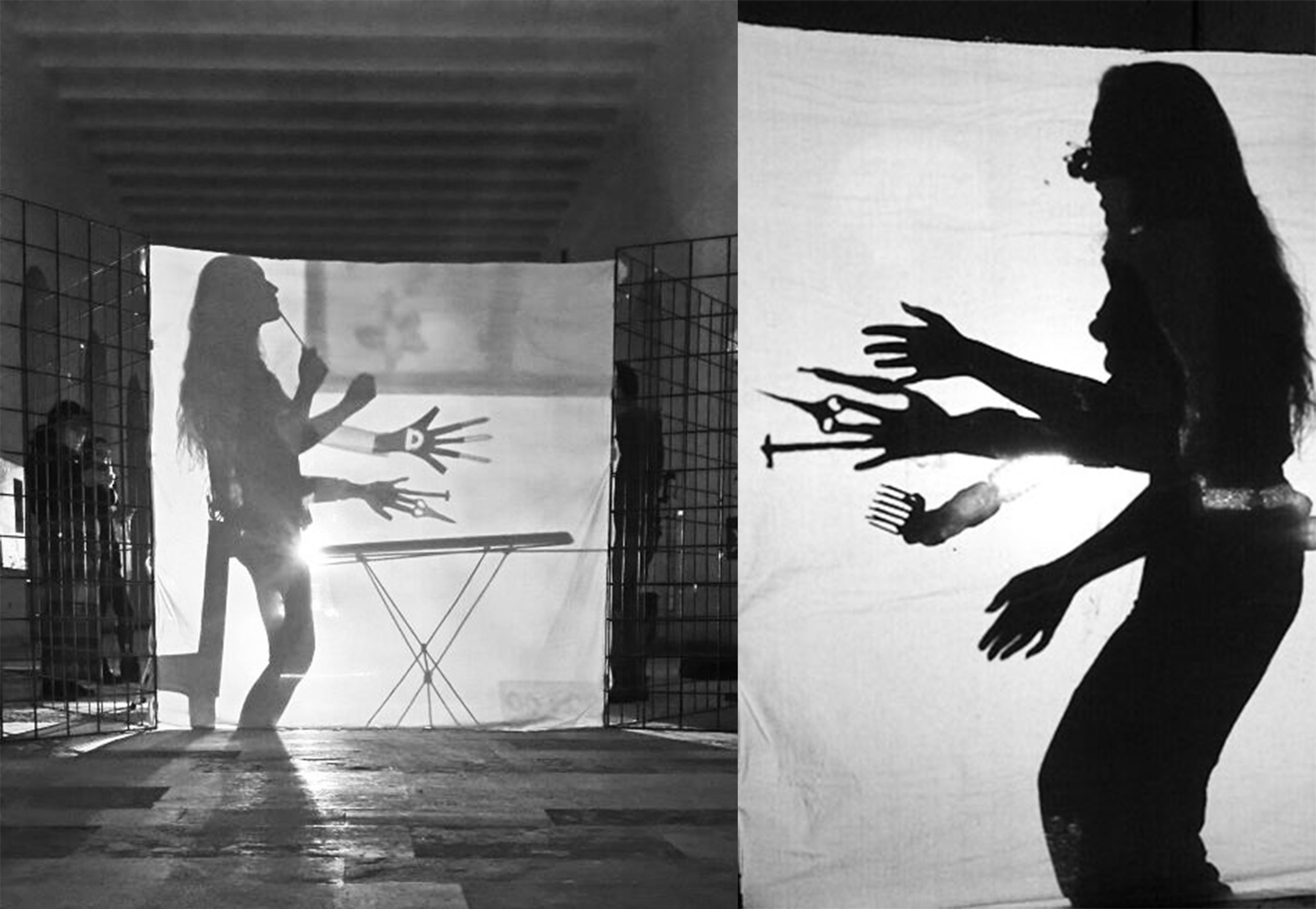
(October 2014 duvardibi teamwork: füsun çetin, gülben bingöl, hülya yavas, melis yükselen, ömer günes, tugçe duman – “the dram of an architect” – prosthesis hands for an architect that has a lot of work to do in short time)
It should not do the things that I can do, it should provide possibilities for me to draw faster or slower that I cannot do in my control. Via this quick or slow drawing experience, I can explore different details about the objects or environment that I want to draw. It should provide different ways to look at to the objects. One of the pieces of it would be like a wearable glasses or a kaleidoscope to multiply the sight, or binoculars to zoom in-out to the objects and explore the details of their surfaces. Maybe when you wear this piece of machine, you can look like a drawing-pirate! (Further thinking: What kind of consequences will arise when it is worn for just one eye or two?) In addition to that, the drawing machine would resemble a camera obscura* but in smaller size or in wearable usage style to be free while drawing. The drawer could also look at the world reversely.
*camera obcsura is the natural optical phenomenon that occurs when an image of a scene at the other side of a screen (or for instance a wall) is projected through a small hole in that screen as a reversed and inverted image (left to right and upside down) on a surface opposite to the opening. (Definition of the camera obscura is taken from wikipedia.org)
It would have different filters to see the world in different ways such as in different-inverted colors or grids with empty surfaces and full surfaces that drawer’s cannot see the part of the scene and by the way the actor of the drawing can imagine new details and make different interpretations for that part. The drawing machine can be a good gaming-dreaming partner!
The drawing machine should be like a memory recorder that after the end of the drawing, drawer could see the process. It would show the superposition of trials. By means of this visible process, the drawer can be a witness to the development of ‘line’. The drawing machine can be considered as a crumpled paper accumulator that values all of the drawings although the producer of them wants to throw them away.
The act of process of recording reminds me this from Berger’s Bento’s Sketchbook:
The image in my head was often clearer than the one on the paper. I redrew and redrew. The paper became grey with alterations and cancelations. The drawing didn’t get better, but gradually she, about to stand up, was more insistently there. And today, like I said, something has happened. The effort of my corrections and the endurance of the paper have begun to resemble the resilience of Maria’s own body. The surface of the drawing – its skin, not its image – make me think of how there are moments when a dancer can make your hairs stand on end. We who draw do so not only to make something observed visible to others, but also to accompany something invisible to its incalculable destination(3).
The drawing machine should break down habits. Drawing is a provocative way of exploring the world. Drawing with not only hands but also another body part or fingers that not accustomed to use or another kind of holding pens can make unexpected consequences. As Dore Ashton said in the article “Introduction: The Freehand’’: ‘’The principal value in freehand drawing lies in the act of disciplining the whole organism —his own, that is— in order to understand with every fiber in his body the true nature of space.” Therefore, the drawing machine should help to use my own body in different way while drawing.
In conclusion, the dreamdrawer machine (it is hard to think drawing and dreaming are distinct from each other, so it can be called as dreamdrawer machine) should liberate me in tangible and intangible ways. It should liberate also the habits of drawing, using the materials, surfaces. It should liberate my hand or my body by providing also physical different pieces that I can use to extend vision and think, see, draw differently.
(1) Paulo Belardi, Why Architects Still Draw
(2) Dore Ashton, “Introduction: The Freehand”, in Sue Fergusson Gassow (ed.), Architects Draw (New York, NY: Princeton Architectural Press, 2008)
(3) John Berger, Bento’ s Sketchbook (London: Verso, 2015)